Travelling to Morocco with a Baby or Toddler: The Practical Guide
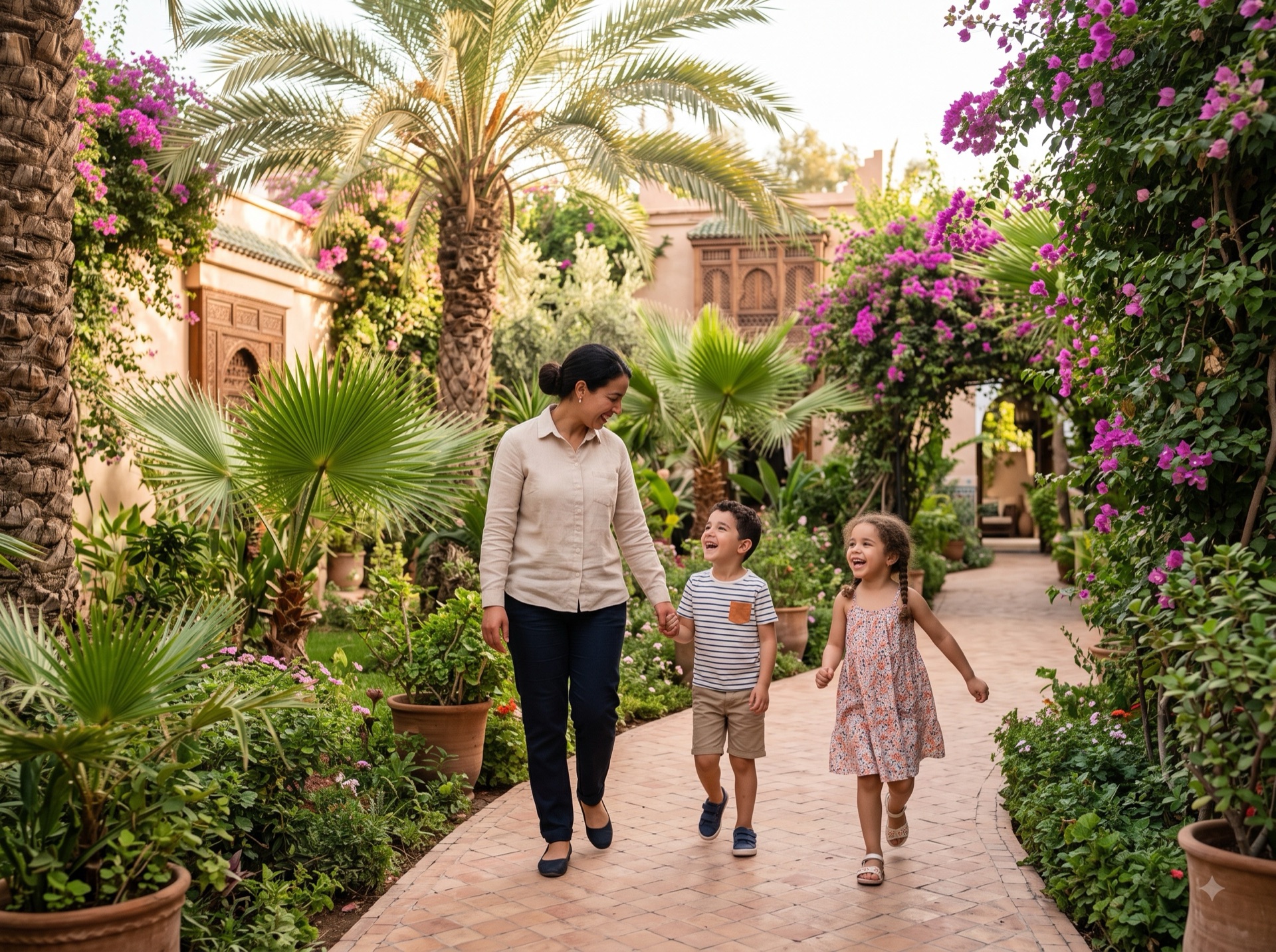
Morocco is a short flight from the UK, the time difference is never more than an hour, and the climate is kind for much of the year — on paper, an ideal destination with a baby. In practice it genuinely is, provided you plan around a few very specific realities that generic travel guides tend to skip. Here is what we tell the families we work with every week in Marrakech, Essaouira and Agadir.
Your child's routine is your best friend
Good news first: with at most an hour's time difference from the UK, jet lag simply isn't a factor. What does disrupt little ones is the holiday itself — souks in the morning, pool in the afternoon, late dinners on a rooftop. Our advice, after hundreds of families: treat the afternoon nap as sacred, somewhere cool, and build sightseeing around it. A well-rested toddler copes brilliantly with the medina; a nap-deprived one will turn the loveliest riad into a battleground.
Those nap windows are exactly why many visiting families arrange in-home childcare during their stay: the nanny stays at the riad while the baby sleeps, and parents use the hottest hours of the day to explore in peace.
Heat and hydration: it depends entirely on the season
From October to April, Marrakech is a delight with a baby — 20 to 25 degrees by day, chilly evenings (pack a warm sleeping bag; riads are barely heated in January). June to September is a different matter: 38 to 45 degrees is routine in Marrakech and Fes. With a young baby, either avoid those two cities at the height of summer or live like the locals do — out before 10am and after 5pm, air-conditioned nap in between.
The clever summer alternative is the coast. Essaouira rarely climbs above 26 degrees thanks to the Atlantic trade winds — families who book a babysitter in Essaouira in July tell us the same thing every year: it is the easiest town in the country with a baby in summer. Agadir offers similar comfort, with long sandy beaches and well-equipped resort hotels.
On hydration: offer the breast or bottle more often than at home, without waiting to be asked. Fewer wet nappies than usual is the earliest sign a baby needs more fluids.
Bottles, formula and baby food: what you can actually buy
Tap water is officially safe in the big cities, but for making up bottles stick to low-mineral bottled water: Sidi Ali and Sidi Harazem are sold in every corner shop, deep inside the medinas included, for a few dirhams.
Moroccan pharmacies stock the major international formula brands (first and follow-on stages). However, if your baby is on a specialist formula — anti-reflux, hypoallergenic, lactose-free — bring your entire supply for the trip: those lines are unavailable or eye-wateringly expensive locally. The same goes for organic pouches: Carrefour and Marjane in Marrakech and Casablanca carry some, but the range is thin, so pack your child's favourites.
In riads, staff will almost always warm a bottle or purée some vegetables — just ask the evening before. It is one of the things that most surprises our clients: in Morocco, asking for anything on behalf of a child is never an imposition.
Getting around: forget the pram in the medina
This is the single most underestimated point. The Marrakech medina — and even more so Fes el-Bali, with its 9,000 sloping alleyways — is genuinely impassable with a pram: uneven cobbles, steps, mopeds, laden donkeys. A structured baby carrier is essential — front-carry before nine months or so, back-carry after. Keep a compact stroller for the modern districts (Gueliz in Marrakech, the Casablanca corniche) and gardens such as the Menara.
Another reality to accept: Moroccan taxis do not have car seats, full stop. For short hops, your child rides on your lap in the back. For longer journeys — the two-and-a-half-hour road to Essaouira, the four hours to Ouarzazate over the Tichka pass — book a private driver with a baby seat (specify it at booking, and confirm again the day before) or hire a car and bring your own seat; rental firms offer them, but quality is a lottery. The ONCF train between Casablanca, Rabat and Fes is a genuinely good option with small children: spacious, air-conditioned, and your baby will charm the entire carriage.
Healthcare: a reassuring private system
Pharmacies are everywhere, marked by a green crescent, and pharmacists usually speak French and some English. Children's paracetamol, rehydration salts and sun cream are all available, often without a prescription. Marrakech has private international clinics with paediatricians and 24-hour A&E; Casablanca has even more choice. A private consultation costs far less than it would in Europe. Take out travel insurance that covers repatriation, and note down a paediatrician's number on arrival — your riad or concierge will happily recommend one.
Before departure, a routine vaccination check with your GP is all that's needed for the tourist areas; no exotic jabs are required.
Sleeping in a riad with a baby: the charm and its traps
Riads are gorgeous, but they are built around an open courtyard: steep staircases with no gates, plunge pools at floor level, roof terraces with railings that would never pass European standards. With a walking toddler, ask for a ground-floor room and inspect the pool the moment you arrive. Most riads can lend a travel cot — reserve it in writing, as many houses only keep one or two. One unexpected bonus: the dawn call to prayer rarely wakes babies, though it sometimes wakes their parents. Earplugs for you, not for them.
If you are dreaming of a candlelit rooftop dinner or an Atlas excursion too long for a small baby, that is the moment to request a childcare quote: a vetted nanny comes to your riad, your child sleeps in their own bed, and you enjoy your evening with a clear head. Every one of our nannies is selected through a strict vetting process.
The advantage no guidebook mentions: the welcome
Moroccans adore children — genuinely, unreservedly. Your baby will be greeted at the restaurant, entertained by the waiter, showered with compliments on Place Moulay Hassan in Essaouira. Children are welcome everywhere, at any hour, evening restaurants included — a restful cultural difference for parents used to disapproving glances back home. It changes everything: travelling with a baby in Morocco is not a holiday of constraints, it is a holiday where your child opens doors.
With a baby carrier, a supply of Sidi Ali water, your usual formula and a protected nap, you have the essentials covered. For everything else — a free evening in Marrakech, a morning's sightseeing in Fes, or regular childcare for the whole stay — we are here.
Many families prefer to book their nanny before they even arrive. If your trip takes you to the red city, see finding a nanny in Marrakech and how we check every profile.